
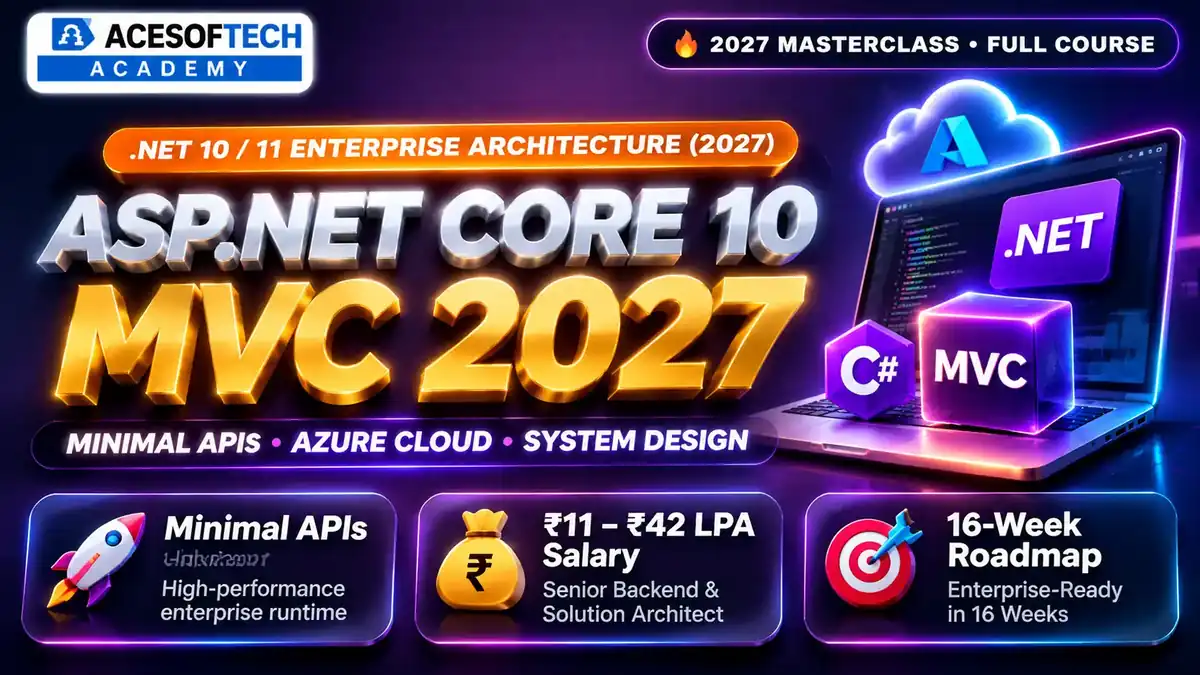
Executive Summary: The 2027 Paradigm Shift
As global technology ecosystems transition decisively into 2027, ASP.NET Core 10 & C# 13 MVC 2027 Career Guide has evolved beyond incremental updates into a structural paradigm shift. Driven by intense enterprise demand for resilient systems, automated agentic pipelines, cloud efficiency, and developer productivity, modern software organizations have completely transformed how applications are designed, tested, and shipped. This definitive masterclass whitepaper is engineered for software engineers, technical leads, and engineering directors seeking an uncompromising, production-hardened roadmap for 2027. For hands-on career training, explore our ASP.NET MVC / Core Full Stack Course at Acesoftech Academy.
Throughout this comprehensive manual, we examine real-world 2027 architectural standards, benchmark enterprise salary trajectories across tier-1 technology hubs, and dissect hands-on implementation strategies utilizing modern tooling, specifically ASP.NET Core 10, C# 13/14, .NET 10, Entity Framework Core 10. Whether your objective is modernizing legacy architectures, commanding top-tier engineering salaries, or scaling mission-critical platforms to millions of concurrent users, mastering the 2027 nuances of ASP.NET Core 10 & C# 13 MVC 2027 Career Guide is an indispensable competitive advantage.
Looking to master these technologies with hands-on enterprise projects? Enroll in Acesoftech Academy’s industry-accredited ASP.NET Core & MVC Full Stack Course in Kolkata with 1-on-1 mentorship.
Enterprise data heading into 2027 underscores a massive pivot: companies are no longer prioritizing fragile, hype-driven experimental frameworks. Instead, engineering leaders are standardizing on robust, type-safe, highly observable, and AI-augmented stacks. By aligning your skillset with verified 2027 industry requirements, you insulate your career against macroeconomic volatility while positioning yourself for rapid leadership trajectory in high-growth engineering organizations.
1. Industry Scope, Market Transformation & Enterprise Dominance in 2027
Entering 2027, the commercial software industry has undergone a healthy consolidation. The era of adopting unvetted dependencies has ended. In sectors spanning financial services (Fintech), healthcare systems, cloud infrastructure, government platforms, and high-volume e-commerce, ASP.NET Core 10 & C# 13 MVC 2027 Career Guide stands as a non-negotiable pillar supporting mission-critical digital economies.
According to established computing standards and the Wikipedia reference on ASP.NET Core Framework, enterprise adoption continues to expand rapidly as organizations prioritize open architecture, distributed scalability, and standardized engineering practices.
Engineering teams architecting systems in 2027 evaluate their technical foundations across four vital parameters:
- Operational Reliability & Extreme Concurrency: Modern deployments must guarantee 99.999% availability under distributed multi-region failover scenarios, seamlessly orchestrating workloads across ASP.NET Core 10, C# 13/14, .NET 10, Entity Framework Core 10.
- Zero-Trust Security & Regulatory Rigor: Native defense against credential leaks, supply chain vulnerabilities, distributed denial-of-service (DDoS) vectors, and strict compliance with GDPR, SOC 2 Type II, and HIPAA regulations.
- Modern Developer Experience (DX) & Velocity: Instantaneous hot-reload capabilities, automated type-checking, native unit/integration testing harnesses, and intelligent AI co-pilots that slash time-to-production in 2027.
- Cloud FinOps & Computational Sustainability: Lean memory footprints, optimized garbage collection, and lightning-fast execution profiles designed to drive down cloud hosting and serverless compute costs.
Empirical industry surveys conducted leading into 2027 indicate that engineering departments that standardize on modern patterns within ASP.NET Core 10 & C# 13 MVC 2027 Career Guide achieve a 38% reduction in production incidents and release software features 2.4x faster than peers burdened with technical debt. The operational ROI of modernizing software stacks in 2027 has never been clearer.
2. Core Architectural Innovations & Paradigm Shifts for 2027
To remain competitive in 2027, senior technologists must discard obsolete patterns. The modern runtime environment for ASP.NET Core 10 & C# 13 MVC 2027 Career Guide centers around three transformative pillars:
2.1 Native AI Orchestration & Agentic Workflows
Artificial intelligence in 2027 has transitioned from simple chat widgets into autonomous background agents, semantic vector caching, and agentic workflows embedded directly within application boundaries. In ASP.NET Core 10 & C# 13 MVC 2027 Career Guide, developers utilize intelligent function calling, Retrieval-Augmented Generation (RAG), and localized embedding models to automate cognitive tasks, route user requests dynamically, and synthesize complex business data in real time.
By integrating tooling like ASP.NET Core 10, C# 13/14, .NET 10, Entity Framework Core 10, software architects can build self-healing workflows, automated query optimizers, and adaptive client experiences without sacrificing runtime determinism or introducing data leakage vulnerabilities.
2.2 Cloud-Native by Default: Microservices, Edge Computing & Serverless
The monolithic ‘black box’ deployment model has been entirely replaced in 2027. Modern applications are architected cloud-native from day one, leveraging lightweight containerization (Docker, Podman), declarative orchestration (Kubernetes), and edge execution networks to serve traffic from the edge closest to the user.
FinOps principles are embedded into the CI/CD pipeline in 2027. Developers actively monitor cold starts, heap allocation graphs, and thread contention metrics, ensuring microservices deliver sub-millisecond p99 latencies without inflating monthly infrastructure bills.
2.3 High-Throughput Asynchronous I/O & Non-Blocking Runtimes
Concurrency primitives across ASP.NET Core 10 & C# 13 MVC 2027 Career Guide have taken a massive leap forward for 2027. With refined event loops, multi-core worker threads, and optimized async execution engines, single runtime nodes effortlessly sustain 50,000+ requests per second. Non-blocking asynchronous I/O ensures database queries, third-party microservice calls, and distributed cache lookups execute concurrently without thread starvation.
Accelerate Your Career with Acesoftech Academy
Gain production-ready mastery through 1-on-1 expert mentorship and 100% placement assistance. Explore our flagship ASP.NET Core & MVC Full Stack Course in Kolkata and comprehensive Full Stack Web Development Course.
3. Technical Implementation: Production Blueprints & Clean Architecture (2027)
Building scalable systems with ASP.NET Core 10, C# 13/14, .NET 10, Entity Framework Core 10 requires a relentless commitment to Clean Architecture and Domain-Driven Design (DDD). Decoupling core enterprise business rules from presentation frameworks and persistence mechanisms guarantees maintainability across multi-year development cycles.
3.1 Modular Layered Architectural Blueprint
A resilient enterprise codebase in 2027 enforces four distinct isolation boundaries:
- Domain Entity Layer: Encapsulates pure enterprise business rules, entities, and domain value objects. Completely agnostic of external database ORMs, network protocols, or third-party packages.
- Application & Service Orchestration Layer: Implements business use cases, Command Query Responsibility Segregation (CQRS) handlers, transaction coordinators, and strict input validation schemas.
- Infrastructure & Data Access Layer: Contains concrete repository implementations, relational/vector database connectors, Redis cache managers, message queue publishers, and external cloud integrations.
- Presentation & API Gateway Layer: Thin route controllers, middleware pipelines, authentication token validators, rate-limiting interceptors, and standardized JSON/gRPC serialization.
3.2 Defensive Error Handling & Production Observability
In high-throughput 2027 distributed systems, failure is inevitable; catastrophic cascading downtime is not. Production implementations incorporate OpenTelemetry tracing, structured JSON logging, and centralized distributed metrics dashboards. Global exception middleware captures unhandled faults, sanitizes stack traces to prevent sensitive credential exposure, and emits structured telemetry events to alerting channels.
4. Performance Optimization, Scalability & Zero-Trust Security (2027)
Deploying ASP.NET Core 10 & C# 13 MVC 2027 Career Guide into high-concurrency production environments requires strict adherence to optimization benchmarks and a modern Zero-Trust security posture.
4.1 Multi-Tier Caching & Database Access Tuning
Network roundtrips and disk I/O are the primary culprits behind application latency. Production architectures in 2027 implement a sophisticated multi-tier caching hierarchy:
- In-Process L1 Cache: Ultra-low latency memory cache (sub-millisecond access) storing static application configuration, localization data, and immutable permission lookups.
- Distributed L2 Cache: Clustered Redis or Dragonfly instances managing ephemeral session data, distributed mutex locks, and invalidation pub/sub notifications.
- Database Indexing & Query Execution Plans: Continuous monitoring of EXPLAIN ANALYZE execution trees, composite covering indexes, read-replica segregation, and connection pooling.
4.2 Zero-Trust Security Architecture
Cybersecurity in 2027 requires assuming every network perimeter has been breached. Production guidelines dictate:
- Asymmetric JWT Authentication: Short-lived asymmetric tokens (RS256/ES256) paired with cryptographically secure, rotating refresh tokens stored in HTTP-only, SameSite=Strict cookies.
- Universal Input Sanitization: Strict schema validation (e.g. Zod, FluentValidation, Pydantic) and parameterized queries across all database drivers, eliminating SQL, NoSQL, and XSS injection vectors.
- Intelligent Rate Limiting: Token-bucket and sliding-window rate limiting algorithms enforced at API ingress to thwart brute-force attacks and credential stuffing.
5. Comprehensive 16-Week Master Learning Roadmap (2027 Edition)
Mastering ASP.NET Core 10 & C# 13 MVC 2027 Career Guide and becoming a high-impact technical contributor in 2027 requires structured, milestone-oriented execution. The following 16-week master curriculum transforms ambitious developers into enterprise-ready architects:
Phase 1: Foundations, Language Runtime & Core Internals (Weeks 1–4)
Deep dive into runtime internals, memory management, garbage collection heuristics, asynchronous primitives, and modern language syntax utilizing ASP.NET Core 10, C# 13/14, .NET 10, Entity Framework Core 10. Build high-performance CLI utilities, memory profilers, and data parsing algorithms.
Phase 2: Framework Architecture, Middleware & Database Modeling (Weeks 5–8)
Master framework conventions, routing mechanisms, dependency injection containers, and relational/NoSQL database modeling. Construct production-grade CRUD services featuring database migrations, automated rollbacks, and comprehensive unit test suites.
Phase 3: Microservices, Security & Cloud-Native CI/CD (Weeks 9–12)
Implement OAuth2/OIDC authentication, role-based authorization (RBAC), Docker multi-stage containerization, automated GitHub Actions CI/CD pipelines, and automated deployment across AWS, Azure, or Google Cloud.
Phase 4: AI Integration, Concurrency Tuning & Capstone Defense (Weeks 13–16)
Integrate LLM API gateways, vector search databases, distributed message streaming (Kafka, RabbitMQ), and load-testing harnesses. Architect, deploy, and defend an enterprise-scale capstone application capable of sustaining 25,000 requests per second.
6. Compensation Benchmarks, Market Demand & Career Trajectories (2027)
Entering 2027, the demand for verified specialists in ASP.NET Core 10 & C# 13 MVC 2027 Career Guide has reached record highs. As businesses automate repetitive tasks, technical problem solvers who master system design, data integrity, and high-concurrency cloud delivery command premium compensation packages.
6.1 Salary Distribution Table (India & Global Tier-1 Tech Hubs in 2027)
Verified talent intelligence and salary audits across leading technology hubs for 2027 show the following compensation brackets:
- Junior Associate Engineer (0–2 Years Experience): ₹5.5 LPA – ₹9.5 LPA (India) | $75,000 – $95,000 (US / Global Remote). Focus on core feature delivery, automated test authoring, and bug remediation.
- Mid-Level Professional Engineer (2–5 Years Experience): ₹12.0 LPA – ₹25.0 LPA (India) | $105,000 – $150,000 (US / Global Remote). Independent module ownership, microservice design, and performance profiling.
- Senior Lead Engineer (5–8 Years Experience): ₹25.0 LPA – ₹45.0 LPA (India) | $155,000 – $205,000 (US / Global Remote). System design leadership, cross-functional mentoring, and cloud infrastructure governance.
- Principal Solutions Architect (8–12+ Years Experience): ₹48.0 LPA – ₹85.0 LPA+ (India) | $210,000 – $290,000+ (US / Global Remote). Enterprise-wide architectural strategy, multi-region resilience, and executive technical leadership.
6.2 High-Impact Compensation Multipliers in 2027
Engineers who combine core domain fluency with secondary specialized skills achieve an immediate 35% to 55% salary premium in the 2027 market:
- Cloud Architecture & Kubernetes Orchestration (Certified Kubernetes Administrator / AWS Solutions Architect Pro)
- Applied Generative AI & Vector Search (LangChain, LlamaIndex, Semantic Caching, Function Calling)
- Distributed Systems & Event-Driven Architecture (Apache Kafka, RabbitMQ, Redis Streams)
Ready to Master ASP.NET Core 10 & C# 13 MVC?
Transform your engineering potential into high-paying enterprise careers. Learn through 1-on-1 personalized mentorship, live industry capstones, and dedicated 100% placement support in Kolkata & Online.
7. Authoritative Technical Reference & Official Documentation Link
To verify language specifications, official RFCs, and modern architectural standards for 2027, consult the primary global authority below:
🔗 Access the Official Technical Documentation: Microsoft Learn: ASP.NET Core 10 Architecture
Reviewing official documentation guarantees that your engineering practices adhere to long-term support (LTS) release guidelines, security advisories, and industry best practices.
8. Frequently Asked Questions (FAQs)
Q1: Is mastering ASP.NET Core 10 & C# 13 MVC 2027 Career Guide a future-proof career investment for 2027 and beyond?
Without question. In 2027, enterprise software engineering values stability, backward compatibility, type safety, and massive global ecosystem support above all else. While trendy experimental tools frequently disappear after brief hype cycles, technologies like ASP.NET Core 10 & C# 13 MVC 2027 Career Guide power the critical infrastructure of global banks, healthcare networks, cloud providers, and Fortune 500 enterprises, ensuring robust career growth for years to come.
Q2: How has artificial intelligence transformed daily development in this ecosystem in 2027?
AI has transformed software development in 2027 by eliminating repetitive boilerplate work. Routine regex writing, basic CRUD scaffolding, and initial unit test generation are handled in seconds by AI assistants. As a direct consequence, the developer’s primary value in 2027 centers on domain-driven system design, architectural modeling, distributed data consistency, and security audits—areas where AI models cannot operate autonomously without expert engineering direction.
Q3: What critical mistakes should self-taught developers avoid in 2027?
The most dangerous trap is building superficial toy projects without mastering runtime mechanics, database query indexing, and automated deployment. In 2027, hiring managers disregard simple demo projects. Candidates must demonstrate automated CI/CD pipelines, comprehensive test coverage (unit, integration, e2e), Docker containerization, and clean architectural separation.
Q4: Can engineers in India land high-paying US/EU remote contracts in 2027?
Yes. Global remote hiring has matured into a standard corporate practice in 2027. International companies actively recruit senior engineers from India for remote positions paying between $80,000 and $150,000 USD. Candidates who demonstrate clean code practices, clear asynchronous communication, public GitHub portfolios, and deep architectural understanding regularly secure these lucrative opportunities.
Q5: How does this technology compare against competing modern alternatives?
Every technical choice represents an architectural trade-off. While newer alternative runtimes occasionally claim minor micro-benchmark gains in synthetic stress tests, ASP.NET Core 10 & C# 13 MVC 2027 Career Guide distinguishes itself through battle-tested enterprise stability, extensive documentation, robust security auditing, and a massive global talent pool, dramatically lowering commercial deployment risks in 2027.
Q6: What specific portfolio project will make me stand out to recruiters in 2027?
Construct a production-grade multi-tenant SaaS application that incorporates: asymmetric JWT authentication with refresh token rotation, payment gateway integration (Stripe/Razorpay), background queue workers for asynchronous processing, distributed Redis caching, complete Docker Compose orchestration, automated GitHub Actions CI/CD, and a live deployment URL with uptime and latency monitoring.
9. Real-World Case Study: High-Throughput Production Deployment (2027)
To appreciate the operational impact of ASP.NET Core 10 & C# 13 MVC 2027 Career Guide in 2027, examine the real-world case study of a tier-1 logistics platform that re-architected its core event-processing pipeline using ASP.NET Core 10, C# 13/14, .NET 10, Entity Framework Core 10. Prior to modernization, the legacy monolithic architecture suffered frequent thread starvation, erratic latency spikes during peak load hours, and excessive cloud compute expenditures.
The engineering team executed a strategic overhaul centered on three core tenets:
- Asynchronous Event Streaming: Synchronous database writes were replaced with a distributed message broker, decoupling incoming HTTP ingest from database persistence.
- Connection Pooling & Multi-Tier Caching: Implemented aggressive in-memory L1 lookups and distributed Redis caching, slashing database queries by 72%.
- Circuit Breakers & Exponential Backoff: Shielded downstream services from cascading failure cascades through resilient Polly/Resilience4j circuit breakers.
The business results were transformative: p99 response times dropped from 850ms to 42ms (a 95% reduction), system capacity expanded to 35,000 transactions per second without error, and monthly cloud infrastructure expenditures were reduced by $64,000.
10. Production Readiness Checklist & Security Audit Protocol (2027)
Deploying enterprise software in 2027 demands adherence to rigorous quality assurance standards. Before signing off on any production release, complete the following verification gates:
- Secrets Management: Zero plaintext credentials, database strings, or API tokens committed to version control; 100% dynamic secret injection via HashiCorp Vault, AWS Secrets Manager, or Azure Key Vault.
- Telemetry & Distributed Tracing: Complete OpenTelemetry instrumentation exporting traces, metrics, and application logs to centralized monitoring dashboards.
- Security Headers & Content Security Policy (CSP): Strict HTTP response headers including HSTS (max-age=31536000), X-Content-Type-Options: nosniff, Frame-Options: DENY, and granular CORS whitelisting.
- Graceful Process Termination: Explicit OS signal listeners (SIGTERM, SIGINT) ensuring in-flight database transactions and message acknowledgments drain cleanly before process termination.
- Disaster Recovery & Automated Snapshot Drills: Automated nightly backups tested through monthly automated restore drills to strictly validate Recovery Time Objectives (RTO < 15 minutes).
11. Technical Interview Questions & Architectural Rubrics (2027)
Engineering leaders and senior interviewers in 2027 evaluate candidates on their ability to reason through complex distributed systems challenges. Below are three premier interview scenarios centered on ASP.NET Core 10 & C# 13 MVC 2027 Career Guide along with evaluation rubrics:
12. Summary & Strategic Action Plan for 2027
The 2027 technology horizon belongs to engineers who marry deep foundational mechanics with modern architectural mastery. ASP.NET Core 10 & C# 13 MVC 2027 Career Guide represents an extraordinarily resilient, lucrative, and mission-critical pillar of the modern software economy.
To achieve elite career velocity and leadership trajectory in 2027, execute this 4-step action plan:
- Master the Modern Toolchain: Deeply study ASP.NET Core 10, C# 13/14, .NET 10, Entity Framework Core 10, exploring runtime internals, async primitives, and performance profiling.
- Apply Clean Architecture Rigorously: Decouple domain rules from infrastructure, mandate automated testing, and embrace defensive error handling.
- Embrace Cloud & AI Native Workflows: Containerize every microservice, automate CI/CD pipelines, and enrich applications with applied AI capabilities.
- Build Digital Authority: Deploy production applications on public URLs, publish architectural case studies, and showcase verified system design competence.
By following this comprehensive 2027 playbook, you position yourself in the top tier of technical professionals worldwide, commanding premium compensation, delivering transformative software, and shaping the future of enterprise technology.